
Democracy Vista
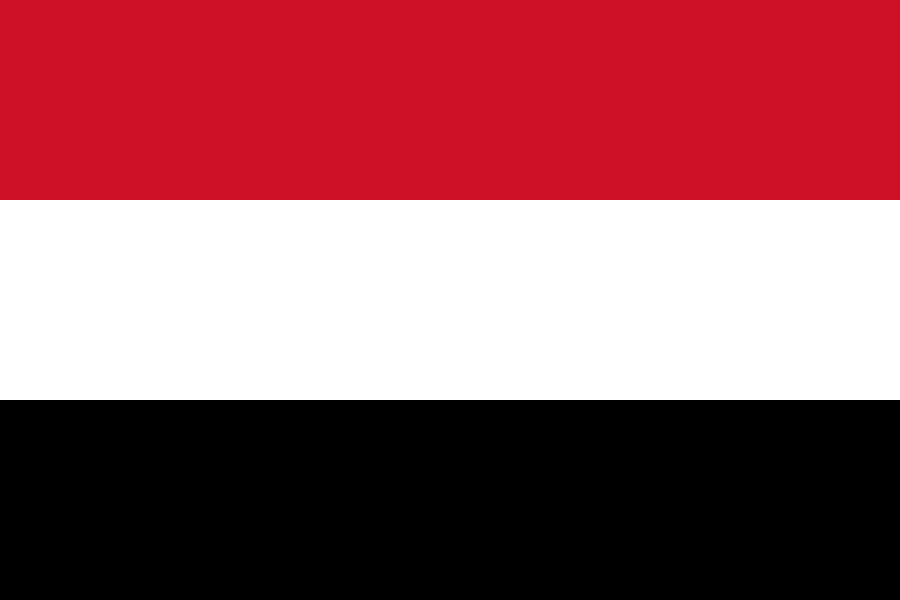
Official national flag of Yemen. Democracy Vista assessment territory.
Official Territory

Yemen

Republic of Yemen

Pop: 32,684,503
Zone: Asia
DEMOVISTA PROPRIETARY // 2026

Liberty
Analysis

A weighted composite metric synthesizing global data on democracy, human rights, economic freedom, and societal development.

3.0INDEX / 10.0
Authoritarian Regime

Supporting
Indices

2.8
SCORE / 10

Democracy Quality

Comprehensive analysis of democratic institutional quality

Authoritarian Regime
4.8
SCORE / 10

Economic Freedom

Degree to which policies and institutions support economic liberty

Hybrid Regime
4.3
SCORE / 10

Human Freedom

A comprehensive measure of personal, civil, and economic freedom

Hybrid Regime
4.3
SCORE / 10

Economic Policy

Analysis of rule of law, government size, and regulatory efficiency

Hybrid Regime
2.0
SCORE / 10

Liberal Democracy

Accountability to citizens through elections and individual rights protection

Authoritarian Regime

Structural
Categories

#150
🗣️

Freedom of Speech

2.7

Severe restrictions on public expression and suppressed media.

Status
#150/ 184
#157
📜

Rule of Law

3.2

Weak rule of law with pervasive legal irregularities.

Status
#157/ 184
#163
👩

Women's Freedom

2.6

Severe restrictions on women's autonomy and legal standing.

Status
#163/ 184
#149
👥

Minorities Freedom

2.9

Systemic discrimination and severe marginalization of minorities.

Status
#149/ 184
#152
🛡️

Crime & Safety

2.8

High violent crime rates and compromised safety infrastructure.

Status
#152/ 184
#161
🗽

Individual Liberties

2.5

Severe constraints on personal autonomy and identity expression.

Status
#161/ 184
#162
🗳️

Democratic Health

2.1

Severe democratic deficits or authoritarian structures.

Status
#162/ 184
#156
🏛️

Institutional Integrity

2.7

Pervasive corruption and lack of government integrity.

Status
#156/ 184
#157
⚖️

Civil Justice

3.3

Compromised legal integrity with systemic political interference.

Status
#157/ 184
#157
📈

Economic Vigor

3.9

Stagnant or highly suppressed economic capacity.

Status
#157/ 184
#159
🏦

Macroeconomic Stability

4.1

Severe currency instability and massive inflation risks.

Status
#159/ 184
#152
🌐

Market Openness

4.2

Closed market with severe barriers to external trade.

Status
#152/ 184
#147
📋

Regulatory Environment

3.8

Hostile regulatory environment stifling operational freedom.

Status
#147/ 184
#159
🌟

Quality of Life

3.7

Critical lack of basic human development infrastructure.

Status
#159/ 184
#165
🌈

Social Tolerance

1.5

Systemic marginalization and lack of minority protections.

Status
#165/ 184
#146
📰

Expression and Information

2.7

High systemic censorship and severe restrictions on expression.

Status
#146/ 184
#149
🤝

Civil Society

2.8

Strict suppression of non-governmental associations.

Status
#149/ 184

Metadata &
Technical Details

Basic Information

Capital

Sana'a

Region

Asia

Subregion

Western Asia

Landlocked

No

Culture & Language

Languages

Arabic

Currencies

Yemeni rial (﷼)

Technical Details

Country Codes

YEYEM

Neighboring Countries

OMN, SAU

Geographic
Hub

Initializing Projections...
Geospatial Context
Coordinates15.00°N, 48.00°E
ProjectionEquirectangular

National
Insights

Background

The Kingdom of Yemen (colloquially known as North Yemen) became independent from the Ottoman Empire in 1918 and in 1962 became the Yemen Arab Republic. The British, who had set up a protectorate area around the southern port of Aden in the 19th century, withdrew in 1967 from what became the People's Republic of Southern Yemen (colloquially known as South Yemen). Three years later, the southern government adopted a Marxist orientation and changed the country's name to the People's Democratic Republic of Yemen. The exodus of hundreds of thousands of Yemenis from the south to the north contributed to two decades of hostility between the states, which were formally unified as the Republic of Yemen in 1990. A southern secessionist movement and brief civil war in 1994 was quickly subdued. In 2000, Saudi Arabia and Yemen agreed to delineate their border. Fighting in the northwest between the government and the Houthis, a Zaydi Shia Muslim minority, continued intermittently from 2004 to 2010, and then again from 2014 to the present. The southern secessionist movement was revitalized in 2007.

Public rallies in Sana'a against then President Ali Abdallah SALIH -- inspired by similar Arab Spring demonstrations in Tunisia and Egypt -- slowly gained momentum in 2011, fueled by complaints over high unemployment, poor economic conditions, and corruption. Some protests resulted in violence, and the demonstrations spread to other major cities. The Gulf Cooperation Council (GCC) mediated the crisis with the GCC Initiative, an agreement in which the president would step down in exchange for immunity from prosecution. SALIH eventually agreed to step down and transfer some powers to Vice President Abd Rabuh Mansur HADI. After HADI's uncontested election victory in 2012, SALIH formally transferred all presidential powers. In accordance with the GCC Initiative, Yemen launched a National Dialogue Conference (NDC) in 2013 to discuss key constitutional, political, and social issues. HADI concluded the NDC in 2014 and planned to proceed with constitutional drafting, a constitutional referendum, and national elections.

The Houthis, perceiving their grievances were not addressed in the NDC, joined forces with SALIH and expanded their influence in northwestern Yemen, which culminated in a major offensive against military units and rival tribes and enabled their forces to overrun the capital, Sana'a, in 2014. In 2015, the Houthis surrounded key government facilities, prompting HADI and the cabinet to resign. HADI fled first to Aden -- where he rescinded his resignation -- and then to Oman before moving to Saudi Arabia and asking the GCC to intervene militarily in Yemen. Saudi Arabia assembled a coalition of Arab militaries and began airstrikes, and ground fighting continued through 2016. In 2016, the UN initiated peace talks that ended without agreement. Rising tensions between the Houthis and SALIH culminated in Houthi forces killing SALIH. In 2018, the Houthis and the Yemeni Government participated in UN-brokered peace talks, agreeing to a limited cease-fire and the establishment of a UN mission.

In 2019, Yemen’s parliament convened for the first time since the conflict broke out in 2014. Violence then erupted between HADI's government and the pro-secessionist Southern Transitional Council (STC) in southern Yemen. HADI's government and the STC signed a power-sharing agreement to end the fighting, and in 2020, the signatories formed a new cabinet. In 2020 and 2021, fighting continued as the Houthis gained territory and also conducted regular UAV and missile attacks against targets in Saudi Arabia. In 2022, the UN brokered a temporary truce between the Houthis and the Saudi-led coalition. HADI and his vice-president resigned and were replaced by an eight-person Presidential Leadership Council. Although the truce formally expired in 2022, the parties nonetheless refrained from large-scale conflict through the end of 2023. Saudi Arabia, after the truce expired, continued to negotiate with the Yemeni Government and Houthis on a roadmap agreement that would include a permanent ceasefire and a peace process under UN auspices.

Yemen Democracy & Freedom Data Analysis | Democracy Vista