
Democracy Vista
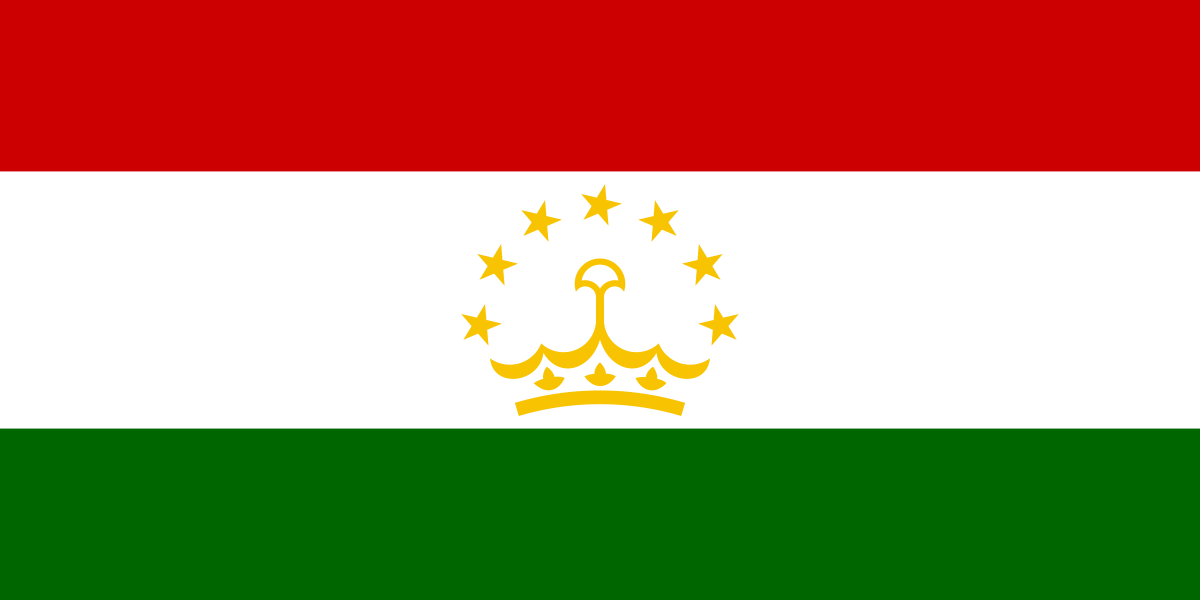
Official national flag of Tajikistan. Democracy Vista assessment territory.
Official Territory

Tajikistan

Republic of Tajikistan

Pop: 10,499,000
Zone: Asia
DEMOVISTA PROPRIETARY // 2026

Liberty
Analysis

A weighted composite metric synthesizing global data on democracy, human rights, economic freedom, and societal development.

3.6INDEX / 10.0
Authoritarian Regime

Supporting
Indices

3.4
SCORE / 10

Democracy Quality

Comprehensive analysis of democratic institutional quality

Authoritarian Regime
5.9
SCORE / 10

Economic Freedom

Degree to which policies and institutions support economic liberty

Hybrid Regime
5.3
SCORE / 10

Human Freedom

A comprehensive measure of personal, civil, and economic freedom

Hybrid Regime
5.7
SCORE / 10

Economic Policy

Analysis of rule of law, government size, and regulatory efficiency

Hybrid Regime
1.8
SCORE / 10

Liberal Democracy

Accountability to citizens through elections and individual rights protection

Authoritarian Regime

Structural
Categories

#153
🗣️

Freedom of Speech

2.6

Severe restrictions on public expression and suppressed media.

Status
#153/ 184
#147
📜

Rule of Law

3.8

Weak rule of law with pervasive legal irregularities.

Status
#147/ 184
#151
👩

Women's Freedom

3.1

Severe restrictions on women's autonomy and legal standing.

Status
#151/ 184
#152
👥

Minorities Freedom

2.8

Systemic discrimination and severe marginalization of minorities.

Status
#152/ 184
#132
🛡️

Crime & Safety

5.1

Moderate crime levels with adequate police response capability.

Status
#132/ 184
#149
🗽

Individual Liberties

3.1

Severe constraints on personal autonomy and identity expression.

Status
#149/ 184
#158
🗳️

Democratic Health

2.2

Severe democratic deficits or authoritarian structures.

Status
#158/ 184
#152
🏛️

Institutional Integrity

3.0

Pervasive corruption and lack of government integrity.

Status
#152/ 184
#152
⚖️

Civil Justice

3.8

Compromised legal integrity with systemic political interference.

Status
#152/ 184
#145
📈

Economic Vigor

5.1

Developing market with average structural freedom.

Status
#145/ 184
#139
🏦

Macroeconomic Stability

5.3

Moderate inflation risk or currency management issues.

Status
#139/ 184
#132
🌐

Market Openness

5.2

Moderate hurdles in international trade and finance.

Status
#132/ 184
#134
📋

Regulatory Environment

4.8

Bureaucratic friction impedes rapid business operations.

Status
#134/ 184
#137
🌟

Quality of Life

5.0

Moderate welfare capacity; localized safety risks exist.

Status
#137/ 184
#134
🌈

Social Tolerance

3.3

Systemic marginalization and lack of minority protections.

Status
#134/ 184
#145
📰

Expression and Information

2.7

High systemic censorship and severe restrictions on expression.

Status
#145/ 184
#155
🤝

Civil Society

2.6

Strict suppression of non-governmental associations.

Status
#155/ 184

Metadata &
Technical Details

Basic Information

Capital

Dushanbe

Region

Asia

Subregion

Central Asia

Landlocked

Yes

Culture & Language

Languages

Russian, Tajik

Currencies

Tajikistani somoni (ЅМ)

Technical Details

Country Codes

TJTJK

Neighboring Countries

AFG, CHN, KGZ, UZB

Geographic
Hub

Initializing Projections...
Geospatial Context
Coordinates39.00°N, 71.00°E
ProjectionEquirectangular

National
Insights

Background

The Tajik people came under Russian imperial rule in the 1860s and 1870s, but Russia's hold on Central Asia weakened following the Revolution of 1917. At that time, bands of indigenous guerrillas (known as "basmachi") fiercely contested Bolshevik control of the area, which was not fully reestablished until 1925. Tajikistan was first established as an autonomous Soviet Socialist Republic within the Uzbek Soviet Socialist Republic in 1924, but in 1929 the Soviet Union made Tajikistan as a separate republic and transferred to it much of present-day Sughd Province. Ethnic Uzbeks form a substantial minority in Tajikistan, and ethnic Tajiks an even larger minority in Uzbekistan. Tajikistan became independent in 1991 after the breakup of the Soviet Union, and the country experienced a civil war among political, regional, and religious factions from 1992 to 1997.

Despite Tajikistan's general elections for both the presidency (once every seven years) and legislature (once every five years), observers note an electoral system rife with irregularities and abuse, and results that are neither free nor fair. President Emomali RAHMON, who came to power in 1992 during the civil war and was first elected president in 1994, used an attack planned by a disaffected deputy defense minister in 2015 to ban the last major opposition party in Tajikistan. RAHMON further strengthened his position by having himself declared "Founder of Peace and National Unity, Leader of the Nation," with limitless terms and lifelong immunity through constitutional amendments ratified in a referendum. The referendum also lowered the minimum age required to run for president from 35 to 30, which made RAHMON's first-born son Rustam EMOMALI, the mayor of the capital city of Dushanbe, eligible to run for president in 2020. RAHMON orchestrated EMOMALI's selection in 2020 as chairman of the Majlisi Milli (the upper chamber of Tajikistan's parliament), positioning EMOMALI as next in line of succession for the presidency. RAHMON opted to run in the presidential election later that year and received 91% of the vote.

The country remains the poorest of the former Soviet republics. Tajikistan became a member of the WTO in 2013, but its economy continues to face major challenges, including dependence on remittances from Tajikistani migrant laborers in Russia and Kazakhstan, pervasive corruption, the opiate trade, and destabilizing violence emanating from neighboring Afghanistan. Tajikistan has endured several domestic security incidents since 2010, including armed conflict between government forces and local strongmen in the Rasht Valley and between government forces and informal leaders in Gorno-Badakhshan Autonomous Oblast. Tajikistan suffered its first ISIS-claimed attack in 2018, when assailants attacked a group of Western bicyclists, killing four. Friction between forces on the border between Tajikistan and the Kyrgyz Republic flared up in 2021, culminating in fatal clashes between border forces in 2021 and 2022.

Tajikistan Democracy & Freedom Data Analysis | Democracy Vista