Democracy Vista
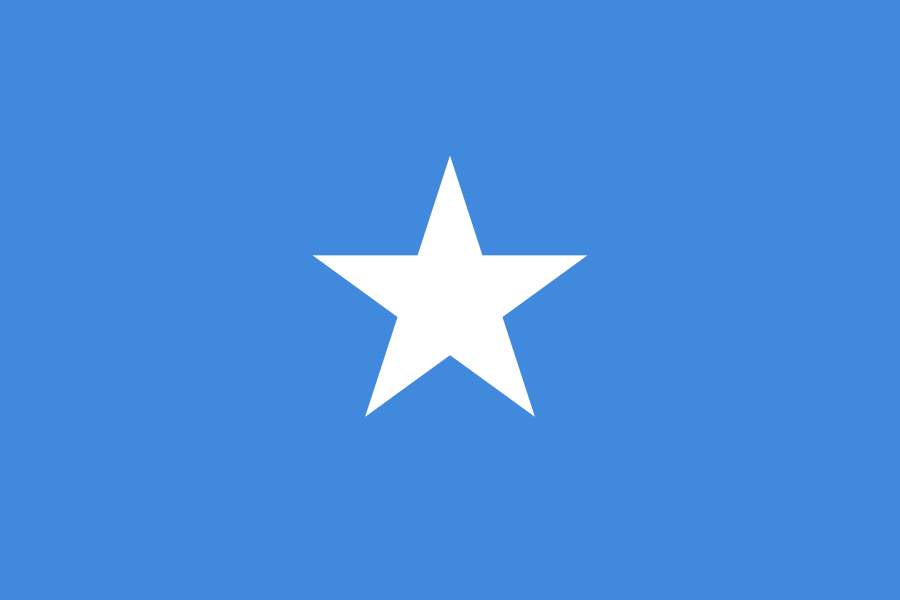
Official national flag of Somalia. Democracy Vista assessment territory.
Official Territory

Somalia

Federal Republic of Somalia

Pop: 19,655,000
Zone: Africa
DEMOVISTA PROPRIETARY // 2026

Liberty
Analysis

A weighted composite metric synthesizing global data on democracy, human rights, economic freedom, and societal development.

3.0INDEX / 10.0
Authoritarian Regime

Supporting
Indices

3.7
SCORE / 10

Democracy Quality

Comprehensive analysis of democratic institutional quality

Authoritarian Regime
5.1
SCORE / 10

Economic Freedom

Degree to which policies and institutions support economic liberty

Hybrid Regime
4.7
SCORE / 10

Human Freedom

A comprehensive measure of personal, civil, and economic freedom

Hybrid Regime
3.5
SCORE / 10

Economic Policy

Analysis of rule of law, government size, and regulatory efficiency

Authoritarian Regime
3.8
SCORE / 10

Liberal Democracy

Accountability to citizens through elections and individual rights protection

Authoritarian Regime

Structural
Categories

#138
🗣️

Freedom of Speech

3.2

Severe restrictions on public expression and suppressed media.

Status
#138/ 184
#159
📜

Rule of Law

3.0

Weak rule of law with pervasive legal irregularities.

Status
#159/ 184
#154
👩

Women's Freedom

3.0

Severe restrictions on women's autonomy and legal standing.

Status
#154/ 184
#140
👥

Minorities Freedom

3.3

Systemic discrimination and severe marginalization of minorities.

Status
#140/ 184
#154
🛡️

Crime & Safety

2.6

High violent crime rates and compromised safety infrastructure.

Status
#154/ 184
#152
🗽

Individual Liberties

2.9

Severe constraints on personal autonomy and identity expression.

Status
#152/ 184
#153
🗳️

Democratic Health

2.3

Severe democratic deficits or authoritarian structures.

Status
#153/ 184
#157
🏛️

Institutional Integrity

2.6

Pervasive corruption and lack of government integrity.

Status
#157/ 184
#134
⚖️

Civil Justice

5.0

Functioning courts with vulnerability to external influence.

Status
#134/ 184
#164
📈

Economic Vigor

3.7

Stagnant or highly suppressed economic capacity.

Status
#164/ 184
#161
🏦

Macroeconomic Stability

4.0

Severe currency instability and massive inflation risks.

Status
#161/ 184
#153
🌐

Market Openness

4.1

Closed market with severe barriers to external trade.

Status
#153/ 184
#153
📋

Regulatory Environment

3.3

Hostile regulatory environment stifling operational freedom.

Status
#153/ 184
#161
🌟

Quality of Life

3.3

Critical lack of basic human development infrastructure.

Status
#161/ 184
#160
🌈

Social Tolerance

1.8

Systemic marginalization and lack of minority protections.

Status
#160/ 184
#143
📰

Expression and Information

2.9

High systemic censorship and severe restrictions on expression.

Status
#143/ 184
#137
🤝

Civil Society

3.2

Strict suppression of non-governmental associations.

Status
#137/ 184

Metadata &
Technical Details

Basic Information

Capital

Mogadishu

Region

Africa

Subregion

Eastern Africa

Landlocked

No

Culture & Language

Languages

Arabic, Somali

Currencies

Somali shilling (Sh)

Technical Details

Country Codes

SOSOM

Neighboring Countries

DJI, ETH, KEN

Geographic
Hub

Initializing Projections...
Geospatial Context
Coordinates10.00°N, 49.00°E
ProjectionEquirectangular

National
Insights

Background

Between A.D. 800 and 1100, immigrant Muslim Arabs and Persians set up coastal trading posts along the Gulf of Aden and the Indian Ocean, solidifying present-day Somalia’s close trading relationship with the Arab Peninsula. In the late 19th century, Britain, France, and Italy established colonies in the Somali Peninsula that lasted until 1960, when British Somaliland gained independence and joined with Italian Somaliland to form the Republic of Somalia.

The country functioned as a parliamentary democracy until 1969, when General Mohamed SIAD Barre took control in a coup, beginning a 22-year socialist dictatorship. In an effort to centralize power, SIAD called for the eradication of the clan, the key cultural and social organizing principle in Somali society. Resistance to SIAD’s socialist leadership, which was causing a rapid deterioration of the country, prompted allied clan militias to overthrow SIAD in 1991, resulting in state collapse. Subsequent fighting between rival clans for resources and territory overwhelmed the country, causing a manmade famine and prompting international intervention. Beginning in 1993, the UN spearheaded an international humanitarian mission, but the international community largely withdrew by 1995 after an incident that became known as Black Hawk Down, in which two US military helicopters were shot down in Mogadishu. The fighting and subsequent siege and rescue resulted in 21 deaths and 82 wounded among the international forces.

International peace conferences in the 2000s resulted in a number of transitional governments that operated outside Somalia. Left largely to themselves, Somalis in the country established alternative governance structures; some areas formed their own administrations, such as Somaliland and Puntland, while others developed localized institutions. Many local populations turned to sharia courts, an Islamic judicial system that implements religious law. Several of these courts came together in 2006 to form the Islamic Courts Union (ICU). The ICU established order in many areas of central and southern Somalia, including Mogadishu, but was forced out when Ethiopia intervened militarily in 2006 on behalf of the Somali Transitional Federal Government (TFG). As the TFG settled in the capital, the ICU fled to rural areas or left Somalia altogether, but the organization reemerged less than a year later as the Islamic insurgent and terrorist movement al-Shabaab, which is still active today.

In 2007, the African Union (AU) established a peacekeeping force, took over security responsibility for the country, and gave the TFG space to develop Somalia’s new government. By 2012, Somali powerbrokers agreed on a provisional constitution with a loose federal structure and established a central government in Mogadishu called the Somali Federal Government (SFG). Since then, the country has seen several interim regional administrations and three presidential elections, but significant governance and security problems remain because al-Shabaab still controls large portions of the country.