
Democracy Vista
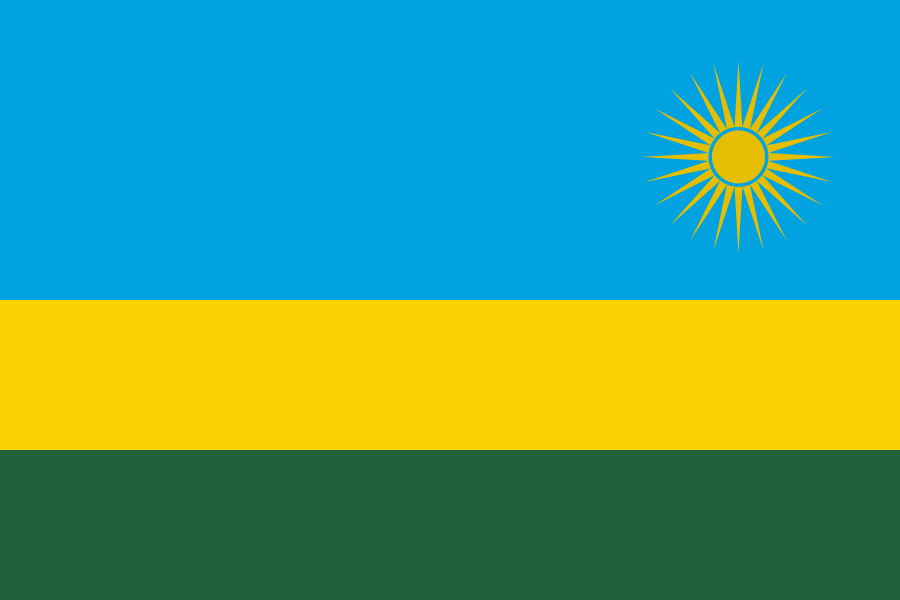
Official national flag of Rwanda. Democracy Vista assessment territory.
Official Territory

Rwanda

Republic of Rwanda

Pop: 14,104,969
Zone: Africa
DEMOVISTA PROPRIETARY // 2026

Liberty
Analysis

A weighted composite metric synthesizing global data on democracy, human rights, economic freedom, and societal development.

4.8INDEX / 10.0
Hybrid Regime

Supporting
Indices

4.4
SCORE / 10

Democracy Quality

Comprehensive analysis of democratic institutional quality

Hybrid Regime
6.8
SCORE / 10

Economic Freedom

Degree to which policies and institutions support economic liberty

Emerging Democracy
6.1
SCORE / 10

Human Freedom

A comprehensive measure of personal, civil, and economic freedom

Emerging Democracy
6.1
SCORE / 10

Economic Policy

Analysis of rule of law, government size, and regulatory efficiency

Emerging Democracy
2.9
SCORE / 10

Liberal Democracy

Accountability to citizens through elections and individual rights protection

Authoritarian Regime

Structural
Categories

#135
🗣️

Freedom of Speech

3.3

Severe restrictions on public expression and suppressed media.

Status
#135/ 184
#106
📜

Rule of Law

5.3

Functional legal systems with occasional inconsistency.

Status
#106/ 184
#133
👩

Women's Freedom

3.7

Severe restrictions on women's autonomy and legal standing.

Status
#133/ 184
#133
👥

Minorities Freedom

3.6

Systemic discrimination and severe marginalization of minorities.

Status
#133/ 184
#115
🛡️

Crime & Safety

5.8

Moderate crime levels with adequate police response capability.

Status
#115/ 184
#135
🗽

Individual Liberties

3.5

Severe constraints on personal autonomy and identity expression.

Status
#135/ 184
#133
🗳️

Democratic Health

2.7

Severe democratic deficits or authoritarian structures.

Status
#133/ 184
#72
🏛️

Institutional Integrity

6.0

Moderate systemic corruption or institutional friction.

Status
#72/ 184
#118
⚖️

Civil Justice

5.5

Functioning courts with vulnerability to external influence.

Status
#118/ 184
#41
📈

Economic Vigor

7.3

Highly agile and capable market economy.

Status
#41/ 184
#86
🏦

Macroeconomic Stability

7.2

Moderate inflation risk or currency management issues.

Status
#86/ 184
#67
🌐

Market Openness

7.2

Moderate hurdles in international trade and finance.

Status
#67/ 184
#28
📋

Regulatory Environment

6.2

Bureaucratic friction impedes rapid business operations.

Status
#28/ 184
#95
🌟

Quality of Life

6.3

Moderate welfare capacity; localized safety risks exist.

Status
#95/ 184
#118
🌈

Social Tolerance

3.8

Systemic marginalization and lack of minority protections.

Status
#118/ 184
#131
📰

Expression and Information

3.3

High systemic censorship and severe restrictions on expression.

Status
#131/ 184
#139
🤝

Civil Society

3.1

Strict suppression of non-governmental associations.

Status
#139/ 184

Metadata &
Technical Details

Basic Information

Capital

Kigali

Region

Africa

Subregion

Eastern Africa

Landlocked

Yes

Culture & Language

Languages

English, French, Kinyarwanda

Currencies

Rwandan franc (Fr)

Technical Details

Country Codes

RWRWA

Neighboring Countries

BDI, COD, TZA, UGA

Geographic
Hub

Initializing Projections...
Geospatial Context
Coordinates-2.00°N, 30.00°E
ProjectionEquirectangular

National
Insights

Background

Rwanda -- a small and centralized country dominated by rugged hills and fertile volcanic soil -- has exerted disproportionate influence over the African Great Lakes region for centuries. A Rwandan kingdom increasingly dominated the region from the mid-18th century onward, with the Tutsi monarchs gradually extending the power of the royal court into peripheral areas and expanding their borders through military conquest. While the current ethnic labels Hutu and Tutsi predate colonial rule, their flexibility and importance have varied significantly over time and often manifested more as a hierarchical class distinction than an ethnic or cultural distinction. The majority Hutu and minority Tutsi have long shared a common language and culture, and intermarriage was frequent.

The Rwandan royal court centered on the Tutsi king (mwami), who relied on an extensive network of political, cultural, and economic relationships. Social categories became more rigid during the reign of RWABUGIRI (1860-1895), who focused on aggressive expansion and solidifying Rwanda’s bureaucratic structures. German colonial conquest began in the late 1890s, but the territory was ceded to Belgian forces in 1916 during World War I. Both European nations quickly realized the benefits of ruling through the already centralized Rwandan Tutsi kingdom. Colonial rule reinforced existing trends toward autocratic and exclusionary rule, leading to the elimination of traditional positions of authority for Hutus. Belgian administrators significantly increased requirements for communal labor and instituted harsh taxes, which fed the population's frustration. Changing political attitudes in Belgium contributed to colonial and Catholic officials shifting their support from Tutsi to Hutu leaders in the years leading up to independence.

Simmering resentment of minority rule exploded in 1959, three years before independence from Belgium, when Hutus overthrew the Tutsi king. Thousands of Tutsis were killed over the next several years, and some 150,000 were driven into exile in neighboring countries. Army Chief of Staff Juvenal HABYARIMANA seized power in a coup in 1973 and ruled Rwanda as a single-party state for two decades. HABYARIMANA increasingly discriminated against Tutsis, and extremist Hutu factions gained prominence after multiple parties were introduced in the early 1990s. The children of Tutsi exiles later formed a rebel group, the Rwandan Patriotic Front (RPF) and began a civil war in 1990. The civil war exacerbated ethnic tensions and culminated in the shooting down of HABYARIMANA’s private jet in 1994. The event sparked a state-orchestrated genocide in which Rwandans killed more than 800,000 of their fellow citizens, including approximately three-quarters of the Tutsi population. The genocide ended later the same year when the predominantly Tutsi RPF, operating out of Uganda and northern Rwanda, defeated the national army and Hutu militias and established an RPF-led government of national unity. Rwanda held its first local elections in 1999 and its first post-genocide presidential and legislative elections in 2003, formalizing President Paul KAGAME’s de facto role as head of government. KAGAME was formally elected in 2010, and again in 2017 after changing the constitution to allow him to run for a third term.

Rwanda Democracy & Freedom Data Analysis | Democracy Vista