Democracy Vista
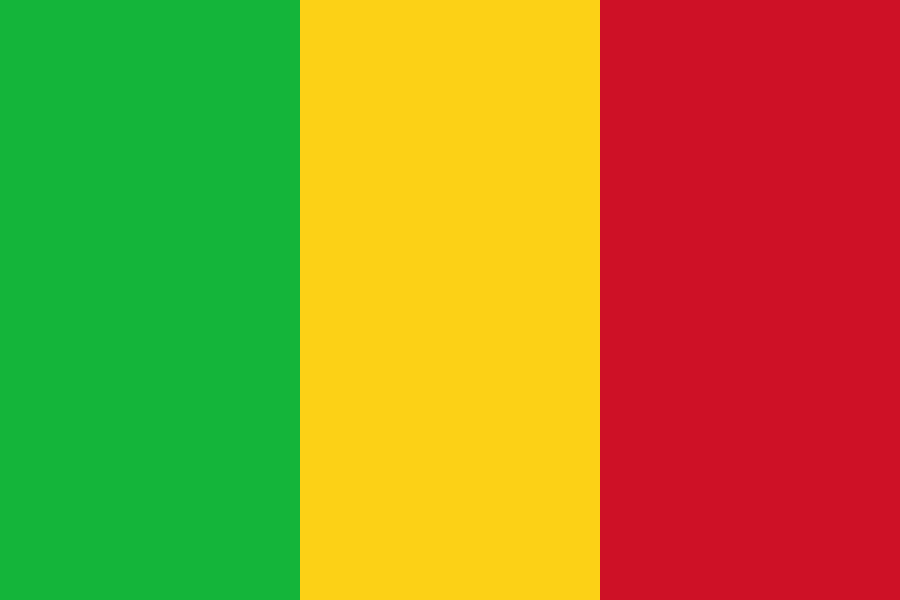
Official national flag of Mali. Democracy Vista assessment territory.
Official Territory

Mali

Republic of Mali

Pop: 22,395,489
Zone: Africa
DEMOVISTA PROPRIETARY // 2026

Liberty
Analysis

A weighted composite metric synthesizing global data on democracy, human rights, economic freedom, and societal development.

4.5INDEX / 10.0
Hybrid Regime

Supporting
Indices

6.1
SCORE / 10

Democracy Quality

Comprehensive analysis of democratic institutional quality

Emerging Democracy
5.5
SCORE / 10

Economic Freedom

Degree to which policies and institutions support economic liberty

Hybrid Regime
6.4
SCORE / 10

Human Freedom

A comprehensive measure of personal, civil, and economic freedom

Emerging Democracy
5.7
SCORE / 10

Economic Policy

Analysis of rule of law, government size, and regulatory efficiency

Hybrid Regime
4.1
SCORE / 10

Liberal Democracy

Accountability to citizens through elections and individual rights protection

Hybrid Regime

Structural
Categories

#119
🗣️

Freedom of Speech

3.8

Severe restrictions on public expression and suppressed media.

Status
#119/ 184
#116
📜

Rule of Law

4.8

Functional legal systems with occasional inconsistency.

Status
#116/ 184
#128
👩

Women's Freedom

3.8

Severe restrictions on women's autonomy and legal standing.

Status
#128/ 184
#111
👥

Minorities Freedom

4.1

Systemic discrimination and severe marginalization of minorities.

Status
#111/ 184
#131
🛡️

Crime & Safety

5.1

Moderate crime levels with adequate police response capability.

Status
#131/ 184
#118
🗽

Individual Liberties

3.9

Severe constraints on personal autonomy and identity expression.

Status
#118/ 184
#128
🗳️

Democratic Health

2.8

Severe democratic deficits or authoritarian structures.

Status
#128/ 184
#121
🏛️

Institutional Integrity

4.5

Pervasive corruption and lack of government integrity.

Status
#121/ 184
#121
⚖️

Civil Justice

5.4

Functioning courts with vulnerability to external influence.

Status
#121/ 184
#103
📈

Economic Vigor

6.2

Developing market with average structural freedom.

Status
#103/ 184
#116
🏦

Macroeconomic Stability

6.3

Moderate inflation risk or currency management issues.

Status
#116/ 184
#131
🌐

Market Openness

5.2

Moderate hurdles in international trade and finance.

Status
#131/ 184
#121
📋

Regulatory Environment

5.0

Bureaucratic friction impedes rapid business operations.

Status
#121/ 184
#131
🌟

Quality of Life

5.2

Moderate welfare capacity; localized safety risks exist.

Status
#131/ 184
#113
🌈

Social Tolerance

3.9

Systemic marginalization and lack of minority protections.

Status
#113/ 184
#112
📰

Expression and Information

3.7

High systemic censorship and severe restrictions on expression.

Status
#112/ 184
#119
🤝

Civil Society

3.8

Strict suppression of non-governmental associations.

Status
#119/ 184

Metadata &
Technical Details

Basic Information

Capital

Bamako

Region

Africa

Subregion

Western Africa

Landlocked

Yes

Culture & Language

Languages

French

Currencies

West African CFA franc (Fr)

Technical Details

Country Codes

MLMLI

Neighboring Countries

DZA, BFA, GIN, CIV, MRT, NER...

Geographic
Hub

Initializing Projections...
Geospatial Context
Coordinates17.00°N, -4.00°E
ProjectionEquirectangular

National
Insights

Background

Present-day Mali is named after the Mali Empire that ruled the region between the 13th and 16th centuries. At its peak in the 14th century, it was the largest and wealthiest empire in West Africa and controlled an area about twice the size of modern-day France. Primarily a trading empire, Mali derived its wealth from gold and maintained several goldfields and trade routes in the Sahel. The empire also influenced West African culture through the spread of its language, laws, and customs, but by the 16th century, it had fragmented into mostly small chiefdoms. The Songhai Empire, previously a Mali dependency centered in Timbuktu, gained prominence in the 15th and 16th centuries. Under Songhai rule, Timbuktu became a large commercial center, well-known for its scholarship and religious teaching. Timbuktu remains a center of culture in West Africa today. In the late 16th century, the Songhai Empire fell to Moroccan invaders and disintegrated into independent sultanates and kingdoms.

France, expanding from Senegal, seized control of the area in the 1890s and incorporated it into French West Africa as French Sudan. In 1960, French Sudan gained independence from France and became the Mali Federation. When Senegal withdrew after only a few months, the remaining area was renamed the Republic of Mali. Mali saw 31 years of dictatorship until 1991, when a military coup led by Amadou Toumani TOURE ousted the government, established a new constitution, and instituted a multi-party democracy. Alpha Oumar KONARE won Mali's first two democratic presidential elections in 1992 and 1997. In keeping with Mali's two-term constitutional limit, he stepped down in 2002 and was succeeded by Amadou Toumani TOURE, who won a second term in 2007.

In 2012, rising ethnic tensions and an influx of fighters -- some linked to Al-Qa’ida -- from Libya led to a rebellion and military coup. Following the coup, rebels expelled the military from the country’s three northern regions, allowing terrorist organizations to develop strongholds in the area. With a 2013 French-led military intervention, the Malian government managed to retake most of the north. However, the government’s grasp in the region remains weak with local militias, terrorists, and insurgent groups competing for control. In 2015, the Malian Government and northern rebels signed an internationally mediated peace accord. Despite a 2017 target for implementation of the agreement, the signatories have made little progress. Terrorist groups were left out of the peace process, and terrorist attacks remain common.  

Ibrahim Boubacar KEITA won the Malian presidential elections in 2013 and 2018. Aside from security and logistic shortfalls, international observers deemed these elections credible. Terrorism, banditry, ethnic-based violence, and extra-judicial military killings plagued the country during KEITA’s second term. In 2020, the military arrested KEITA, his prime minister, and other senior members of the government and established a military junta called the National Committee for the Salvation of the People (CNSP). The junta then established a transition government and appointed Bah N’DAW, a retired army officer and former defense minister, as interim president and Colonel Assimi GOITA, the coup leader and chairman of the CNSP, as interim vice president. The transition government’s charter allowed it to rule for up to 18 months before calling a general election.  

In 2021, GOITA led a military takeover, arresting the interim president after a Cabinet shake-up removed GOITA’s key allies. GOITA was sworn in as transition president, and Choguel Kokalla MAIGA was sworn in as prime minister. In 2022, the Economic Community of West African States (ECOWAS) imposed sanctions on the transition government, and member states closed their borders with Mali after the transition government presented a five-year extension to the electoral calendar. The transition government and ECOWAS agreed to a new two-year timeline, which would have included presidential elections in February 2024, but the transition government postponed the elections indefinitely in September 2023 and withdrew from ECOWAS in January 2024.