
Democracy Vista
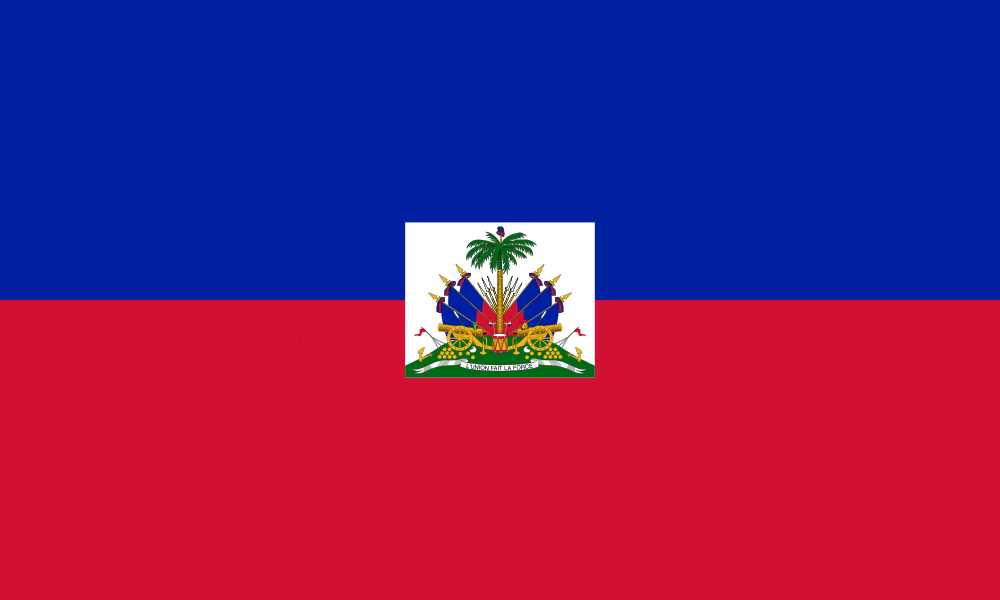
Official national flag of Haiti. Democracy Vista assessment territory.
Official Territory

Haiti

Republic of Haiti

Pop: 11,867,032
Zone: Americas
DEMOVISTA PROPRIETARY // 2026

Liberty
Analysis

A weighted composite metric synthesizing global data on democracy, human rights, economic freedom, and societal development.

3.9INDEX / 10.0
Authoritarian Regime

Supporting
Indices

4.9
SCORE / 10

Democracy Quality

Comprehensive analysis of democratic institutional quality

Hybrid Regime
6.3
SCORE / 10

Economic Freedom

Degree to which policies and institutions support economic liberty

Emerging Democracy
6.9
SCORE / 10

Human Freedom

A comprehensive measure of personal, civil, and economic freedom

Emerging Democracy
5.2
SCORE / 10

Economic Policy

Analysis of rule of law, government size, and regulatory efficiency

Hybrid Regime
3.6
SCORE / 10

Liberal Democracy

Accountability to citizens through elections and individual rights protection

Authoritarian Regime

Structural
Categories

#129
🗣️

Freedom of Speech

3.5

Severe restrictions on public expression and suppressed media.

Status
#129/ 184
#151
📜

Rule of Law

3.4

Weak rule of law with pervasive legal irregularities.

Status
#151/ 184
#139
👩

Women's Freedom

3.5

Severe restrictions on women's autonomy and legal standing.

Status
#139/ 184
#127
👥

Minorities Freedom

3.8

Systemic discrimination and severe marginalization of minorities.

Status
#127/ 184
#117
🛡️

Crime & Safety

5.7

Moderate crime levels with adequate police response capability.

Status
#117/ 184
#133
🗽

Individual Liberties

3.5

Severe constraints on personal autonomy and identity expression.

Status
#133/ 184
#147
🗳️

Democratic Health

2.4

Severe democratic deficits or authoritarian structures.

Status
#147/ 184
#154
🏛️

Institutional Integrity

2.9

Pervasive corruption and lack of government integrity.

Status
#154/ 184
#133
⚖️

Civil Justice

5.0

Functioning courts with vulnerability to external influence.

Status
#133/ 184
#112
📈

Economic Vigor

6.0

Developing market with average structural freedom.

Status
#112/ 184
#122
🏦

Macroeconomic Stability

6.1

Moderate inflation risk or currency management issues.

Status
#122/ 184
#65
🌐

Market Openness

7.2

Moderate hurdles in international trade and finance.

Status
#65/ 184
#140
📋

Regulatory Environment

4.2

Hostile regulatory environment stifling operational freedom.

Status
#140/ 184
#146
🌟

Quality of Life

4.4

Critical lack of basic human development infrastructure.

Status
#146/ 184
#121
🌈

Social Tolerance

3.7

Systemic marginalization and lack of minority protections.

Status
#121/ 184
#130
📰

Expression and Information

3.3

High systemic censorship and severe restrictions on expression.

Status
#130/ 184
#132
🤝

Civil Society

3.5

Strict suppression of non-governmental associations.

Status
#132/ 184

Metadata &
Technical Details

Basic Information

Capital

Port-au-Prince

Region

Americas

Subregion

Caribbean

Landlocked

No

Culture & Language

Languages

French, Haitian Creole

Currencies

Haitian gourde (G)

Technical Details

Country Codes

HTHTI

Neighboring Countries

DOM

Geographic
Hub

Initializing Projections...
Geospatial Context
Coordinates19.00°N, -72.42°E
ProjectionEquirectangular

National
Insights

Background

The native Taino -- who inhabited the island of Hispaniola when Christopher COLUMBUS first landed in 1492 -- were virtually wiped out by Spanish settlers within 25 years. In the early 17th century, the French established a presence on Hispaniola. In 1697, Spain ceded to the French the western third of the island, which later became Haiti. The French colony, based on forestry and sugar-related industries, became one of the wealthiest in the Caribbean but relied heavily on the forced labor of enslaved Africans and environmentally degrading practices. In the late 18th century, Toussaint L'OUVERTURE led a revolution of Haiti's nearly half a million slaves that ended France's rule on the island. After a prolonged struggle, and under the leadership of Jean-Jacques DESSALINES, Haiti became the first country in the world led by former slaves after declaring its independence in 1804, but it was forced to pay an indemnity of 100 million francs (equivalent to $22 billion USD in March 2023) to France for more than a century and was shunned by other countries for nearly 40 years. In 1862, the US officially recognized Haiti, but foreign economic influence and internal political instability induced the US to occupy Haiti from 1915 to 1934.

Francois "Papa Doc" DUVALIER and then his son Jean-Claude "Baby Doc" DUVALIER led repressive and corrupt regimes that ruled Haiti in 1957-1971 and 1971-1986, respectively. Jean-Bertrand ARISTIDE was Haiti's first democratically elected president in 1991 and was elected a second time in 2000, but coups interrupted his first term after only a few months and ended his second term in 2004. President Jovenel MOÏSE was assassinated in 2021, leading the country further into an extra-constitutional governance structure and contributing to the country’s growing fragility. The Government of Haiti then installed Ariel HENRY -- whom President MOÏSE had nominated shortly before his death -- as prime minister.

On 29 February 2024, a significant escalation of gang violence occurred on the 20th anniversary of ARISTIDE's second overthrow, after the announcement that HENRY would not hold elections until August 2025. HENRY’s return from an overseas trip was diverted to Puerto Rico when the airport closed due to gang violence. With control of much of the capital, Port-au-Prince, gang leaders called for the ouster of HENRY’S government. By mid-March, Haiti’s continued violence, HENRY’S inability to return to the country, and increasing pressure from the international community led HENRY to pledge to resign. On 25 April 2024, HENRY formally submitted his resignation as a nine-member Transitional Presidential Council assumed control, tasked with returning stability to the country and preparing elections. Since January 2023, Haiti has had no sitting elected officials.

The country has long been plagued by natural disasters. In 2010, a major 7.0 magnitude earthquake struck Haiti with an epicenter about 25 km (15 mi) west of the capital, Port-au-Prince. An estimated 300,000 people were killed, and some 1.5 million left homeless. The earthquake was assessed as the worst in this region in 200 years. A 7.2 magnitude earthquake hit Haiti’s southern peninsula in 2021, causing well over 2,000 deaths; an estimated 500,000 required emergency humanitarian aid. Haiti is the poorest country in the Western Hemisphere, as well as one of the most unequal in wealth distribution.